 CLEANMIST
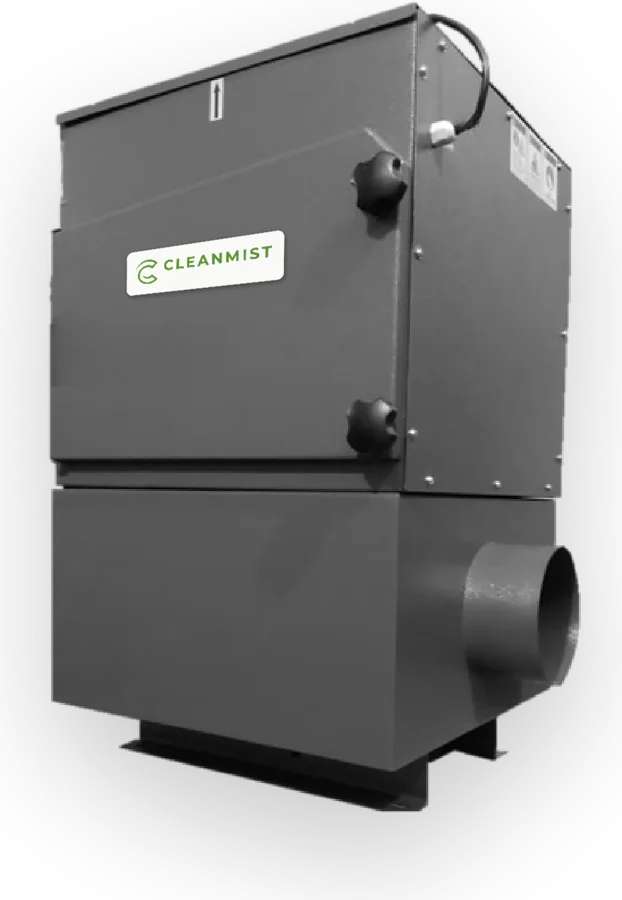
High-pressure coolant mist extraction
Through-spindle and high-pressure coolant keeps tools cool and clears chips, but it also breaks the fluid into finer mist inside the enclosure. Share your machine, fluid and coolant pressure so extraction can be matched to the duty.
Pressure turns coolant into finer mist
High-pressure and through-spindle coolant does its job at the cutting edge - and the same pressure that clears chips also atomises the fluid. The enclosure fills with a fine mist that escapes at every door open for part loading, tool checks and setup, and through any unsealed gaps. Over a shift, that mist settles as a film on machines, floors and the operator's clothes. Extraction belongs at the enclosure, running with the machine.
The fluid decides the duty
Emulsion coolant: CM series
Water-mix coolant, at any pressure, is an emulsion-mist duty. The CM series brochure lists suitability for oil and emulsion mist across CM600, CM1100, CM1500 and CM2000 (rated 600 to 2000 CMH).
Neat oil at high pressure: ESP series
The ESP series brochure lists high-pressure straight-oil machining on turning centers, machining centers and Swiss-type lathes among its applications. Electrostatic cells capture the fine oil particles and drain the recovered oil.
Finer mist, same principle
Higher pressure makes the mist finer, which is why the collector is matched to the fluid and enclosure rather than to the machine brand or the coolant pressure alone.
Not a washing duty
High-pressure coolant mist is a machining emission. Mist and steam from component washing machines are a different duty - see the parts washer mist and steam guide.
Choosing the unit
The CM series covers 600-2000 CMH (100-260 W, 230 V) and the ESP series covers ESP1000 (1000-1500 CMH, 250 W), ESP2000 (2000 CMH, 430 W) and ESP4000 (4000 CMH, 770 W) on a 220-240 V single-phase supply. These are collector ratings from the brochures, not confirmed airflow requirements for any specific machining centre or turning center.
At the enclosure
A collector mounted on or beside the machine draws mist straight from the enclosure before it reaches the operator's breathing zone. Send photos of the enclosure roof and any existing extraction opening.
Per-machine or shared
One unit per machine suits machines on different fluids or patterns; a row of similar machines can share a ducted arrangement when airflow is planned for the combined duty - see the centralised vs per-machine guide.
Maintenance
CM units use 3-stage cassette filtration (wire mesh, 20 PPI foam, 40 PPI foam). ESP collecting cells are washed and reused, with no disposable media in the standard configuration; the optional HEPA after-filter is a separate replaceable element.
Runs with the machine
Extraction works when it runs with the spindle. The collector can be wired so extraction is on whenever the machine is cutting.
What to send us before choosing
Machine
Make and model of the machining centre, turning center or Swiss-type lathe, and whether it is fully enclosed.
Fluid and pressure
The coolant or oil product name and the coolant pressure rating from the machine specification; the safety data sheet helps confirm the duty.
Working pattern
Hours per day, how often the enclosure door opens, and whether the machine runs attended or lights-out.
Layout
Photos of the enclosure roof, the space above and beside the machine, and any existing extraction or ducting.
Common questions about high-pressure coolant mist
Does high-pressure coolant need different extraction than flood coolant?
The fluid decides the duty, and pressure makes the mist finer. Water-mix coolant at any pressure is an emulsion-mist duty for the CM series; the ESP series brochure lists high-pressure straight-oil machining for neat-oil work on turning centers, machining centers and Swiss-type lathes. Confirm the fluid and pressure before choosing.
Which Cleanmist unit suits a VMC with through-spindle coolant?
It depends on the enclosure volume and the fluid. The CM series covers 600-2000 CMH across CM600 to CM2000 for emulsion mist; ESP1000 and ESP2000 cover neat-oil duty. These are brochure collector ratings, not confirmed airflow requirements for any specific machine - share the machine model and enclosure details.
The enclosure is well sealed. Is extraction still needed?
Sealing slows the spread, but mist escapes at every door open for part loading, tool checks and setup, and through any unsealed gaps. Extraction arranged at the enclosure keeps the internal air moving to the collector instead of into the shop when the door opens.
What maintenance do the collectors need on coolant mist?
The CM series uses 3-stage cassette filtration (wire mesh, 20 PPI foam, 40 PPI foam) that is cleaned or replaced as it loads. ESP collecting cells are washed and reused, with no disposable media in the standard configuration; the optional HEPA after-filter is a separate replaceable element.
What should I send first for a high-pressure coolant application?
Your machine make and model, the coolant or oil product name, the coolant pressure rating from the machine specification, photos of the enclosure roof and any existing extraction opening, and how many hours per day the machine runs.
Send your coolant setup
Share your machine, fluid and coolant pressure. We will review the application before recommending a unit or arrangement.
WhatsApp my machine detailsProduct specifications and application coverage from the Cleanmist CM and ESP series brochures. Updated 13 November 2026.