 CLEANMIST
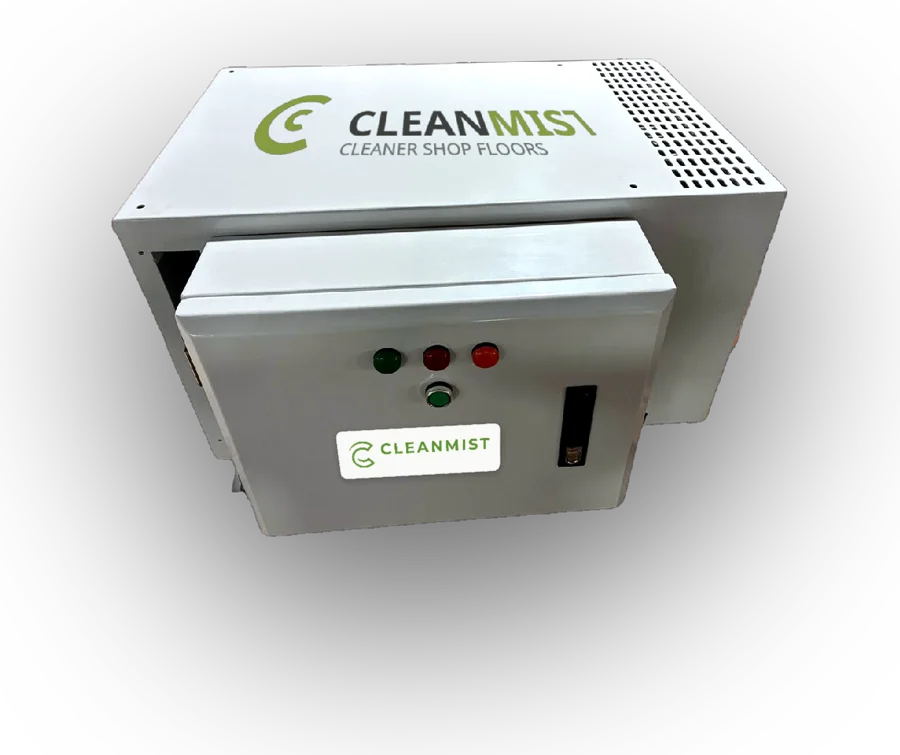
Oil quench smoke extraction
Every time a hot part enters the quench oil, a dense burst of smoke leaves the tank. Share your tank, oil and working pattern so extraction can be matched to the duty.
Quench smoke comes in bursts, all shift long
Hardening shops quench hot steel parts in oil, and each immersion drives a burst of fine oil smoke off the tank surface. Unlike the steady mist from a CNC enclosure, quench smoke arrives in repeated slugs, once per load, all shift. Without capture at the tank, each burst reaches the operator's breathing zone and spreads as an oily film across the furnace area and the shop.
Quench duty is not machining mist duty
A smoke, not a coolant mist
Quenching hot parts in oil produces a fine, sub-micron oil smoke. The Cleanmist ESP series brochure lists oil quench among its applications; electrostatic cells capture the fine particles and drain the recovered oil.
Burst pattern
The heavy emission lasts from immersion until the part cools below the smoke point, then eases. Sizing has to handle the burst, not just the average.
Open tanks
Quench tanks are open so parts can enter and leave. Capture is arranged at or above the tank edge, and headroom for the hoist or basket handling shapes the layout.
Hot surroundings
Furnaces, hot parts and oil handling sit close together in a heat treatment cell. Mention the furnace position and part travel path when you send details, so the pickup does not fight the workflow.
Choosing the extraction arrangement
The ESP series covers ESP1000 (rated 1000-1500 CMH, 250 W), ESP2000 (2000 CMH, 430 W) and ESP4000 (4000 CMH, 770 W), on a 220-240 V single-phase supply with 99% filtration efficiency. These are collector ratings from the brochure, not confirmed airflow requirements for any specific quench tank.
At the tank
A pickup arranged at the tank edge or above the bath captures smoke where it leaves the oil. Send a photo of the tank, the space above it, and how parts are lowered in.
Per-tank or shared
One ESP per tank suits tanks on different cycles. Tanks on similar patterns can share a ducted arrangement when airflow is planned for the combined duty.
Washable cells
ESP collecting cells are washed and reused; the standard configuration uses no disposable filter media. A washable metal-mesh pre-filter catches larger droplets, and the optional HEPA after-filter is a separate replaceable element.
Recovered oil
Electrostatic collection drains the captured oil for handling per your shop's practice, instead of loading it into throwaway media.
What to send us before choosing
Tank and oil
Tank dimensions (length, width, depth), whether the tank has a cover or agitation, and the quench oil product name. The safety data sheet helps confirm the duty.
Parts and temperature
Typical part size and weight, roughly how hot parts are when they enter the oil, and whether loads go in by hand, hoist or basket.
Working pattern
Quenches per shift, hours per day, and whether quenching runs in batches or continuously.
Layout
A photo of the tank area and the space above and beside it, the furnace position, and any existing extraction or ducting.
Common questions about oil quench smoke extraction
Is oil quench smoke the same duty as CNC coolant mist?
No. Coolant mist from machining is an oil or emulsion mist duty, which the CM series mist collectors cover. Quenching hot parts in oil produces a fine oil smoke, and the ESP series brochure lists oil quench among its electrostatic applications. Tell us which process you run before choosing a unit.
Are the ESP collecting cells washable?
Yes. The ESP cells are washed and reused; the standard configuration uses no disposable filter media. An optional HEPA after-filter is a separate replaceable element.
Can one ESP serve more than one quench tank?
It can when ducting and airflow are planned for the combined duty. Share the tank positions, their sizes and how often each is used, and the arrangement can be checked.
What should I send first for a quench application?
Your tank dimensions, the quench oil product name, a rough idea of part size and how hot parts are when they enter the oil, how many quenches happen per shift, and a photo of the tank area and the space above it.
Does extraction have to run only while parts are being quenched?
The smoke burst happens at immersion and for a short time after, but fumes also drift while parts cool in and above the oil. Continuous or well-timed extraction at the tank covers both; the working pattern decides what is practical.
Send your quench setup
Share your tank size, quench oil and working pattern. We will review the application before recommending a unit or arrangement.
WhatsApp my quench detailsProduct specifications from the Cleanmist ESP series brochure. Updated 5 November 2026.